The Nerdz Lounge.

I predict that her relationship with James will be over well before mid-season. I say there's a good chance they don't ever even get past first base.

I feel the same way. But, to be honest, the two actors have zero chemistry together. And, his Jimmy Olsen is as flat as it can be.
 
I feel the same way. But, to be honest, the two actors have zero chemistry together. And, his Jimmy Olsen is as flat as it can be.

He had that mind control thing happen. So, he won't remember any of it anyway. In regards to the chemistry and Jimmy being flat, the writing is rather poor. They do well in regards to how they portray the women on the show, but fail when portraying the men. They need to hire a few new writers to fix that. Hopefully the CW will fix that.
 
He had that mind control thing happen. So, he won't remember any of it anyway. In regards to the chemistry and Jimmy being flat, the writing is rather poor. They do well in regards to how they portray the women on the show, but fail when portraying the men. They need to hire a few new writers to fix that. Hopefully the CW will fix that.

Amen
 
It may come off like that, but this is the first season after all and he was dealing with Lucy before really moving on to Kara and the final episode was more of a way to cement that they are officially together.

The show's writing isn't the best when it comes to portraying the guys, but it's a show with a feminist bent (nothing wrong with that), as there have been shows with male leads with female supporting characters who were just there to be the love interest and not much more developed, so the dynamics are more of a reversal of roles, but the show is heavily concentrated on the female leads and characters like Martian Manhunter.

Still, the second season is suppose to be more "comic-book like" and there will be opportunities for characters to develop well beyond their thin portrayals in the first season.

I feel the same way. But, to be honest, the two actors have zero chemistry together. And, his Jimmy Olsen is as flat as it can be.
 
It may come off like that, but this is the first season after all and he was dealing with Lucy before really moving on to Kara and the final episode was more of a way to cement that they are officially together.

The show's writing isn't the best when it comes to portraying the guys, but it's a show with a feminist bent (nothing wrong with that), as there have been shows with male leads with female supporting characters who were just there to be the love interest and not much more developed, so the dynamics are more of a reversal of roles, but the show is heavily concentrated on the female leads and characters like Martian Manhunter.

Still, the second season is suppose to be more "comic-book like" and there will be opportunities for characters to develop well beyond their thin portrayals in the first season.


Yeah and many even the doubters felt the season finale episode was the best chemistry they showed since the beginning, if they continue like that I can see a long standing relationship, but they just might include a love triangle with either Wynn or Cat Grant's son or go back to the Lucy triangle love story just to make it interesting. You know how they do a lot of relationships on shows.
 
Yeah and many even the doubters felt the season finale episode was the best chemistry they showed since the beginning, if they continue like that I can see a long standing relationship, but they just might include a love triangle with either Wynn or Cat Grant's son or go back to the Lucy triangle love story just to make it interesting. You know how they do a lot of relationships on shows.

If it's on the CW, then there must be a love triangle. It's in The Constitution right before the 2nd Amendment.
 
I think it's settled since Winn is clearly in the friendzone territory and encouraged James to go for her. As for Cat Grant's son, he'll likely appear, but won't have a prominent role. If anything, introducing Maggie Sawyer, and (possibly) Katherine Kane, and the notice of a major character exploring her sexuality, I think we'll have more relationships besides the Kara and James love relationship.

Yeah and many even the doubters felt the season finale episode was the best chemistry they showed since the beginning, if they continue like that I can see a long standing relationship, but they just might include a love triangle with either Wynn or Cat Grant's son or go back to the Lucy triangle love story just to make it interesting. You know how they do a lot of relationships on shows.
 
Arrow?
The 100?
Supernatural?
Arrow: Felicity, Ollie and Ray. Larel, Ollie and Malcolm Merlin's son.

The 100? I don't know anything about it. I've heard it's good, though.

Supernatural: bromance love triangle between Cass, Dean and Crowley. You don't notice it because it's not sexual and your mind just won't let you go there. ...lol

But it's there. They just gave it a twist and thought we wouldn't notice.
 
I remember back in the day there was buffy and angel and dawson's creek ... miss those days.

Who would ever think pasey having a relationship with a teacher would be so relevant today.
 
[youtube]/FtbM_W9iNjg[/youtube]


A new trailer for Underworld: Blood Wars has arrived, and with it comes the return of Kate Beckinsale.

The film is due out in theaters January 6, 2017.
 
Early Luke Cage Review from Collider.com


'Luke Cage’ Review: Netflix Delivers the Hero We Need


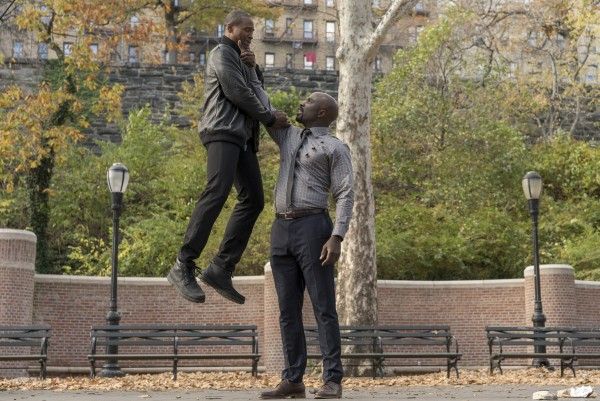
luke-cage-mike-colter-3-600x401.jpg


BY ALLISON KEENE
collider.com

One of the best things about Marvel’s growing set of series on Netflix is how each has managed to create its own distinct feel while not straying too far from the overall tone. Daredevil is dark, literally, and contains some of the universe’s most grisly violence, while Jessica Jones’ narrative bleakness is tempered by a bright banter. Luke Cage is smooth and deliberate, with Cage himself (Mike Colter) fighting to move both himself and his neighborhood into the light. All three protagonists struggle with the idea of heroism, and how they fit into a world forever changed by “The Incident” (see: The Avengers). But they do, each finding their own way to a path that will, eventually, bring them all together with Iron Fist for The Defenders.

But for now, each story belongs uniquely to its title protagonist, and while Luke Cage had an important impact on Jessica Jones’ story, his own series finds him removed from those events. Taking place several months after Jessica Jones, Cage has relocated to Harlem from Hell’s Kitchen, and is attempting to keep a low profile. He’s barely making ends meet as he sweeps hair at a local barbershop (owned by the neighborhood’s father figure Pops, played by Frankie Faison of The Wire and Banshee), and cleans dishes at a nightclub owned by the crime boss Cornell “Cottonmouth” Stokes (Mahershala Ali). It doesn’t take very long for those stories to connect, as young regulars at the barbershop see an opportunity for quick cash that soon turns bloody. The fallout from this is what pushes Cage to finally move forward with his life and embrace his strengths for the protection of those who need it.

Colter has described the series as Marvel’s version of The Wire, which is bold yet in many ways apt. It’s an intimate portrait of street life, detailing not only the inner workings of the crime syndicates, but also the beleaguered police, sleazy politicians, and the young people in the community who see guns and drugs as an easy way to make money.

Luke Cage, it should be noted, hates guns, and one of the great delights of his fight sequences is not just the physicality he uses to overpower his foes (he wasn’t called Power Man in the comics for nothing, and there are some great nods to Cage’s comic history throughout the season), but also in how he pointedly destroys their firearms as he goes. As he tells Pops, “a man with a gun has no father.”

Cage is a physical badass, as demonstrated in a number of thrillingly satisfying scenes, but he has a much quieter side. He reads the New Yorker and discusses his preference for the crime writing of George Pelecanos, and has serious opinions on Bruce Lee versus Jet Li. He’s a gentleman hero, and a reluctant one. But when he’s threatened by a young man with a gun who calls him the n-word, Cage – even after a long day full of emotional toil –confronts him. “Do you see a n— standing in front of you?” he asks, also asking if the boy knows the significance of the historical black hero, Crispus Attucks, featured on the building in front of them. “I see a dead n—“ the boy replies. Cage sets him straight.

Race matters in Luke Cage, but most especially in the way that the show fully embraces its Harlem location with style and substance. There’s an intimacy of place here, and it extends to all corners of the series in cultural specificity and details. The idea of Luke Cage not just as a hero, but as a black superhero, is important here.


In that way and others, Luke Cage is a story that’s about more than a vigilante. Jessica Jones dealt brilliantly with the complicated, important issues of rape, consent, power, and being a survivor, and this series also deals with difficult real-world issues that go beyond metahumans and cartoon villains. As with Daredevil, it’s about changing the viewpoint of the community to not allow a villain to rule just because it’s easier. Cornell and his politician sister Mariah (Alfre Woodard) are like the two sides of Kingpin. Cornell cares about the money, power, and respect, while Mariah uses those means to get to her altruistic ends. It’s a complicated corruption.

Speaking of the other Defenders, fans of Jessica Jones will miss Krysten Ritter‘s investigator and her electric spark with Cage dearly as the series begins. But another heroine soon arrives: Misty Knight (Simone Missick), a detective who not only has her own bright banter and connection with Cage, but who is her own brand of badass. Missick is luminous in the role, bringing a fiery energy to Misty that’s smart, sexy, and a little mysterious. It’s a perfect mirror for Cage, especially since she’s strong, well-written, and not a traditional sidekick or love interest. The same is true for Luke’s wife Reva (Parisa Fitz-Henley), who returns in flashbacks to connect us not only to Luke’s superpowered origins and her own role in them, but also to connect the story back to the events revealed in Jessica Jones.

Luke Cage does an excellent job giving each of its cast members (however long they stick around) distinct personalities and memorable moments that create immediate stakes. Theo Rossi’s Shades isn’t just Cornell’s henchman, he has his own unique story, and one that’s closely tied to Cage’s past. Similarly, Frank Whaley’s Rafael Scarfe, as Misty’s partner, isn’t forgotten or written off as back-up. In this world, everyone has a place, and it matters.

But none shine as brightly as Colter. Like we saw glimpses of in Jessica Jones, he gives Cage a sense of reticence mixed with righteous defiance that hits all the right notes for a hero who uses his strength only as a last resort, and he does so in low tones and with a casual confidence. Though Cage isn’t always confident, he’s extremely principled with a magnetic charisma, making him a kind of Captain America to this ragtag group of vigilantes. Though he may struggle to define his heroism and what it means for himself and Harlem, there are no complications for viewers. He is the hero we’ve been waiting for.

Rating: ????? Excellent

Luke Cage premieres Friday, September 30th on Netflix.
 

'Luke Cage’ Review: Netflix Delivers the Hero We Need


luke-cage-mike-colter-3-600x401.jpg


BY ALLISON KEENE
collider.com

One of the best things about Marvel’s growing set of series on Netflix is how each has managed to create its own distinct feel while not straying too far from the overall tone. Daredevil is dark, literally, and contains some of the universe’s most grisly violence, while Jessica Jones’ narrative bleakness is tempered by a bright banter. Luke Cage is smooth and deliberate, with Cage himself (Mike Colter) fighting to move both himself and his neighborhood into the light. All three protagonists struggle with the idea of heroism, and how they fit into a world forever changed by “The Incident” (see: The Avengers). But they do, each finding their own way to a path that will, eventually, bring them all together with Iron Fist for The Defenders.

But for now, each story belongs uniquely to its title protagonist, and while Luke Cage had an important impact on Jessica Jones’ story, his own series finds him removed from those events. Taking place several months after Jessica Jones, Cage has relocated to Harlem from Hell’s Kitchen, and is attempting to keep a low profile. He’s barely making ends meet as he sweeps hair at a local barbershop (owned by the neighborhood’s father figure Pops, played by Frankie Faison of The Wire and Banshee), and cleans dishes at a nightclub owned by the crime boss Cornell “Cottonmouth” Stokes (Mahershala Ali). It doesn’t take very long for those stories to connect, as young regulars at the barbershop see an opportunity for quick cash that soon turns bloody. The fallout from this is what pushes Cage to finally move forward with his life and embrace his strengths for the protection of those who need it.

Colter has described the series as Marvel’s version of The Wire, which is bold yet in many ways apt. It’s an intimate portrait of street life, detailing not only the inner workings of the crime syndicates, but also the beleaguered police, sleazy politicians, and the young people in the community who see guns and drugs as an easy way to make money.

Luke Cage, it should be noted, hates guns, and one of the great delights of his fight sequences is not just the physicality he uses to overpower his foes (he wasn’t called Power Man in the comics for nothing, and there are some great nods to Cage’s comic history throughout the season), but also in how he pointedly destroys their firearms as he goes. As he tells Pops, “a man with a gun has no father.”

Cage is a physical badass, as demonstrated in a number of thrillingly satisfying scenes, but he has a much quieter side. He reads the New Yorker and discusses his preference for the crime writing of George Pelecanos, and has serious opinions on Bruce Lee versus Jet Li. He’s a gentleman hero, and a reluctant one. But when he’s threatened by a young man with a gun who calls him the n-word, Cage – even after a long day full of emotional toil –confronts him. “Do you see a n— standing in front of you?” he asks, also asking if the boy knows the significance of the historical black hero, Crispus Attucks, featured on the building in front of them. “I see a dead n—“ the boy replies. Cage sets him straight.

Race matters in Luke Cage, but most especially in the way that the show fully embraces its Harlem location with style and substance. There’s an intimacy of place here, and it extends to all corners of the series in cultural specificity and details. The idea of Luke Cage not just as a hero, but as a black superhero, is important here.


In that way and others, Luke Cage is a story that’s about more than a vigilante. Jessica Jones dealt brilliantly with the complicated, important issues of rape, consent, power, and being a survivor, and this series also deals with difficult real-world issues that go beyond metahumans and cartoon villains. As with Daredevil, it’s about changing the viewpoint of the community to not allow a villain to rule just because it’s easier. Cornell and his politician sister Mariah (Alfre Woodard) are like the two sides of Kingpin. Cornell cares about the money, power, and respect, while Mariah uses those means to get to her altruistic ends. It’s a complicated corruption.

Speaking of the other Defenders, fans of Jessica Jones will miss Krysten Ritter‘s investigator and her electric spark with Cage dearly as the series begins. But another heroine soon arrives: Misty Knight (Simone Missick), a detective who not only has her own bright banter and connection with Cage, but who is her own brand of badass. Missick is luminous in the role, bringing a fiery energy to Misty that’s smart, sexy, and a little mysterious. It’s a perfect mirror for Cage, especially since she’s strong, well-written, and not a traditional sidekick or love interest. The same is true for Luke’s wife Reva (Parisa Fitz-Henley), who returns in flashbacks to connect us not only to Luke’s superpowered origins and her own role in them, but also to connect the story back to the events revealed in Jessica Jones.

Luke Cage does an excellent job giving each of its cast members (however long they stick around) distinct personalities and memorable moments that create immediate stakes. Theo Rossi’s Shades isn’t just Cornell’s henchman, he has his own unique story, and one that’s closely tied to Cage’s past. Similarly, Frank Whaley’s Rafael Scarfe, as Misty’s partner, isn’t forgotten or written off as back-up. In this world, everyone has a place, and it matters.

But none shine as brightly as Colter. Like we saw glimpses of in Jessica Jones, he gives Cage a sense of reticence mixed with righteous defiance that hits all the right notes for a hero who uses his strength only as a last resort, and he does so in low tones and with a casual confidence. Though Cage isn’t always confident, he’s extremely principled with a magnetic charisma, making him a kind of Captain America to this ragtag group of vigilantes. Though he may struggle to define his heroism and what it means for himself and Harlem, there are no complications for viewers. He is the hero we’ve been waiting for.

Rating: ????? Excellent

Luke Cage premieres Friday, September 30th on Netflix.

Try as I might, I just can't seem to get pumped for this show. But, I'm going to watch it anyway and spread the word to anyone that will listen.

I'm hoping the show will be good enough to win me over like Black Panther's appearance in Civil.War did. Never cared about BP till then. Now, I've just ordered the DVD's of the motion comic and can't wait till his movie hits the theaters. Going to start picking up the comic, too. Haven't bought a comic in a few years.
 
I'm prolly the only one here who thinks this is kinda dope. But, whatever ...
I was always a big fan of those old school serials.[YOUTUBE]K74mu3m8Jxk[/YOUTUBE]
 
I'm prolly the only one here who thinks this is kinda dope. But, whatever ...
I was always a big fan of those old school serials.[YOUTUBE]K74mu3m8Jxk[/YOUTUBE]

I grew up on the old serials. I love the fight scenes.

Check out the film J-Men Forever. It links almost every Republic serial hero in one hilarious classic thanks to The Firesign Theater. They changed the films by rerecording New dialogue. It is on DVD now and it has an interview with George Wallace, who played Commando Cody, the Flying Rocketman.
 

'Luke Cage’ Review: Netflix Delivers the Hero We Need


luke-cage-mike-colter-3-600x401.jpg


BY ALLISON KEENE
collider.com

One of the best things about Marvel’s growing set of series on Netflix is how each has managed to create its own distinct feel while not straying too far from the overall tone. Daredevil is dark, literally, and contains some of the universe’s most grisly violence, while Jessica Jones’ narrative bleakness is tempered by a bright banter. Luke Cage is smooth and deliberate, with Cage himself (Mike Colter) fighting to move both himself and his neighborhood into the light. All three protagonists struggle with the idea of heroism, and how they fit into a world forever changed by “The Incident” (see: The Avengers). But they do, each finding their own way to a path that will, eventually, bring them all together with Iron Fist for The Defenders.

But for now, each story belongs uniquely to its title protagonist, and while Luke Cage had an important impact on Jessica Jones’ story, his own series finds him removed from those events. Taking place several months after Jessica Jones, Cage has relocated to Harlem from Hell’s Kitchen, and is attempting to keep a low profile. He’s barely making ends meet as he sweeps hair at a local barbershop (owned by the neighborhood’s father figure Pops, played by Frankie Faison of The Wire and Banshee), and cleans dishes at a nightclub owned by the crime boss Cornell “Cottonmouth” Stokes (Mahershala Ali). It doesn’t take very long for those stories to connect, as young regulars at the barbershop see an opportunity for quick cash that soon turns bloody. The fallout from this is what pushes Cage to finally move forward with his life and embrace his strengths for the protection of those who need it.

Colter has described the series as Marvel’s version of The Wire, which is bold yet in many ways apt. It’s an intimate portrait of street life, detailing not only the inner workings of the crime syndicates, but also the beleaguered police, sleazy politicians, and the young people in the community who see guns and drugs as an easy way to make money.

Luke Cage, it should be noted, hates guns, and one of the great delights of his fight sequences is not just the physicality he uses to overpower his foes (he wasn’t called Power Man in the comics for nothing, and there are some great nods to Cage’s comic history throughout the season), but also in how he pointedly destroys their firearms as he goes. As he tells Pops, “a man with a gun has no father.”

Cage is a physical badass, as demonstrated in a number of thrillingly satisfying scenes, but he has a much quieter side. He reads the New Yorker and discusses his preference for the crime writing of George Pelecanos, and has serious opinions on Bruce Lee versus Jet Li. He’s a gentleman hero, and a reluctant one. But when he’s threatened by a young man with a gun who calls him the n-word, Cage – even after a long day full of emotional toil –confronts him. “Do you see a n— standing in front of you?” he asks, also asking if the boy knows the significance of the historical black hero, Crispus Attucks, featured on the building in front of them. “I see a dead n—“ the boy replies. Cage sets him straight.

Race matters in Luke Cage, but most especially in the way that the show fully embraces its Harlem location with style and substance. There’s an intimacy of place here, and it extends to all corners of the series in cultural specificity and details. The idea of Luke Cage not just as a hero, but as a black superhero, is important here.


In that way and others, Luke Cage is a story that’s about more than a vigilante. Jessica Jones dealt brilliantly with the complicated, important issues of rape, consent, power, and being a survivor, and this series also deals with difficult real-world issues that go beyond metahumans and cartoon villains. As with Daredevil, it’s about changing the viewpoint of the community to not allow a villain to rule just because it’s easier. Cornell and his politician sister Mariah (Alfre Woodard) are like the two sides of Kingpin. Cornell cares about the money, power, and respect, while Mariah uses those means to get to her altruistic ends. It’s a complicated corruption.

Speaking of the other Defenders, fans of Jessica Jones will miss Krysten Ritter‘s investigator and her electric spark with Cage dearly as the series begins. But another heroine soon arrives: Misty Knight (Simone Missick), a detective who not only has her own bright banter and connection with Cage, but who is her own brand of badass. Missick is luminous in the role, bringing a fiery energy to Misty that’s smart, sexy, and a little mysterious. It’s a perfect mirror for Cage, especially since she’s strong, well-written, and not a traditional sidekick or love interest. The same is true for Luke’s wife Reva (Parisa Fitz-Henley), who returns in flashbacks to connect us not only to Luke’s superpowered origins and her own role in them, but also to connect the story back to the events revealed in Jessica Jones.

Luke Cage does an excellent job giving each of its cast members (however long they stick around) distinct personalities and memorable moments that create immediate stakes. Theo Rossi’s Shades isn’t just Cornell’s henchman, he has his own unique story, and one that’s closely tied to Cage’s past. Similarly, Frank Whaley’s Rafael Scarfe, as Misty’s partner, isn’t forgotten or written off as back-up. In this world, everyone has a place, and it matters.

But none shine as brightly as Colter. Like we saw glimpses of in Jessica Jones, he gives Cage a sense of reticence mixed with righteous defiance that hits all the right notes for a hero who uses his strength only as a last resort, and he does so in low tones and with a casual confidence. Though Cage isn’t always confident, he’s extremely principled with a magnetic charisma, making him a kind of Captain America to this ragtag group of vigilantes. Though he may struggle to define his heroism and what it means for himself and Harlem, there are no complications for viewers. He is the hero we’ve been waiting for.

Rating: ????? Excellent

Luke Cage premieres Friday, September 30th on Netflix.

I can't wait for this
 
Avengers: Infinity War Set Photo Reveals Josh Brolin as Thanos

thanos-guardians.jpg


Thanos has arrived.

Although principal photography of Marvel’s “Avengers: Infinity War” isn’t scheduled to begin until November, directors Anthony and Joe Russo today unveiled a behind-the-scenes look at Thanos actor Josh Brolin dressed in his motion-capture suit. The accompanying text reads simply “Rehearsal.”

In the photo, the Russo brothers appear to be chatting with Brolin, who’s casually sitting on a platform in a spacious room lined with machinery and scaffolding.


Marvel Studios has spent more than four years seeding Thanos as the primary threat “in the Marvel Cinematic Universe, dating back to the 2012 release of “The Avengers.” Loki’s defeat in the film’s climax looked to be an unmitigated success for the newly formed team of heroes, but in a post-credits scene, a mysterious character known as “The Other” met with Thanos to discuss the problem of Earth’s Mightiest Heroes. That scene marked the Jim Starlin-created villain’s entrance into the MCU.

Thanos didn’t appear again until 2014’s “Guardians of the Galaxy,” where he was used sparingly (and mostly in hologram form), serving as an evil, intimidating presence throughout the film and coming into conflict with main villain Ronan the Accuser — as well as his two adopted daughters, Gamora and Nebula. “Guardians” marked Brolin’s first appearance as Thanos, as he did motion-capture and voiceover work for the film. Marvel Studios President Kevin Feige described Brolin as “totally intrigued” by the role and “a fan of what [Marvel Studios] did.”

Since then, Marvel’s films have continued to plant seeds for an upcoming showdown with the nihilistic Titan, best known for his love of Death (literally) and command of the Infinity Gauntlet. The various McGuffins present in the films (such as the Red Skull’s Tesseract, Loki’s staff and Malekith’s Aether) were all eventually revealed to be manifestations of the Infinity Stones that power the Gauntlet, and in a post-credits scene from 2015’s “Avengers: Age of Ultron,” Thanos is shown to be in possession of the ominous glove.

The 2014 reveal of the “Infinity War” subtitle for the third Avengers film served as confirmation that the team would finally battle the mad Titan.

“Avengers: Infinity War” arrives May 4, 2018, followed by an as-yet-untitled sequel on May 3, 2019.
 
Back
Top Bottom