As I have pointed out to you time and time again per this link
https://www.vox.com/2014/4/11/56022...ortations-a-very-short-history-of-immigration
"Many critics of the Obama administration who want more immigrants expelled from the country point to the removals/returns distinction in order to argue that Obama is inflating his record on enforcement. After all, the total of removals
plus returns is lower under Obama than it was under Bush.
But this argument is both overly simplistic and needlessly confusing. The story of the Obama administration on immigration enforcement is that more people than ever are being expelled from the country in a way that prevents them from returning to the US legally or illegally — even though net unauthorized migration has been low and the unauthorized population of the country is down from its 2006 peak.
That's a perfectly suitable definition of "deportation." The government simply can't return more people than are trying to come in to begin with — so returns are partly dependent on the state of the economy. Removals, on the other hand, tell the story of the deliberate policy choices made over the last decade that are having lasting consequences for the people being expelled.
"Removals have much harsher consequences than returns
PEOPLE WHO ARE RETURNED ARE NOT SUBJECT TO FORMAL CONSEQUENCES
Unauthorized immigrants who are removed from the country are
ineligible to apply to re-enter legally for a period of years. If they try to come back to the US illegally and succeed (as of 1996) their removal order is
"reinstated" and they can be deported again without another trial.
People who are returned, by contrast, are not subject to formal consequences — they can turn back around and try again, or they can apply to re-enter the country legally.
Some critics
took issue with that characterization — and the dispute here hinges on the fact that there's no longer any official definition of "deportation." The terminology has changed as policy has changed, and that's creating some confusion today as to what should count as a deportation.
THERE'S NO LONGER AN OFFICIAL DEFINITION OF 'DEPORTATION'
Currently, the federal government uses two different terms for when it apprehends an unauthorized immigrant and expels him or her from the country. There are "removals," which involve a formal court order. And then there are "returns," which do not. In my article, I used "deportations" to refer to removals only — for reasons explained below.
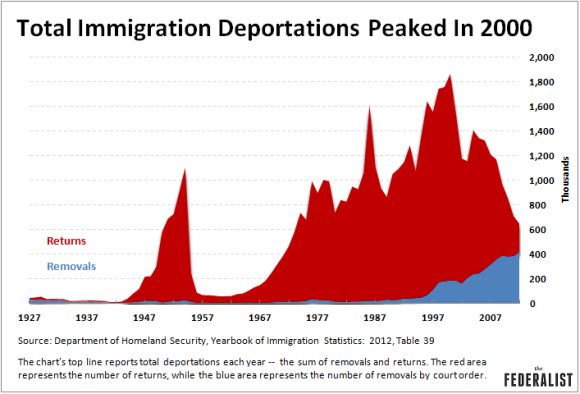
This distinction matters a fair bit. The Obama administration is on pace for more
removals than any president in history. But there have been far fewer
returns under Obama than under George W. Bush (chart via
The Federalist,* which counts both "removals" and "returns" as "deportations"):
So if you think that measuring returns plus removals is the best way to judge enforcement, then it looks like Obama is less tough than Bush. But there's a strong argument that removals are the appropriate metric to use in this debate. Here's why.
Deportation' is no longer an official legal term
"Deportation" was an official legal term before 1996 — any time the government removed someone from inside the country who was in the US unlawfully, that was considered a deportation.
The Bush administration started the trend of putting a heavier emphasis on removals
During the Bush administration, the thriving economy drew a lot of unauthorized migration. Many of these people were apprehended at the border. Still, many slipped through and
the unauthorized population grew significantly.
CRITICS CALLED RETURNS "CATCH-AND-RELEASE" — SO BUSH RAMPED UP REMOVALS
At the time, many critics derided the Bush administration's returns as a
"catch-and-
release" system — the administration was turning away people at the border who would then come back and try again.
So, in response, the Bush administration decided to ramp up the number of formal orders of removal (and criminal charges) for people who would previously have been returned, says Theresa Brown of the Bipartisan Policy Center, who was a Customs and Border Protection and Department of Homeland Security official at the time.
Bush officials figured that relying more heavily on removals would deter people from repeatedly trying to cross the border. This system has persisted under Obama, and is now part of what's called the
Consequence Delivery System.
https://www.vox.com/2014/4/11/56022...ortations-a-very-short-history-of-immigration
Bliss, you are so stuck on the idea that Obama was soft on immigration, a liar, and whatever other negative adjective you want to throw out there you just cannot admit the truth on numerous topics. Face it Bliss, politics is RARELY straight forward and does not lend itself to easy answers and labels, to quote one of my favorite movies, "America isn't easy. America is advanced citizenship. You gotta want it bad" and NUMEROUS facts support the narrative that Obama was an EXCEPTIONAL president on many different levels, including immigration.
Holder did not decline to prosecute sanctuary cities, this article provide more clarity and context
http://www.washingtontimes.com/news/2010/jul/14/justice-sanctuary-cities-are-no-arizona/




 ..l'm merely stating these parents out here aren't dissuaded by those fears that aren't present at the grade-school level. And as a child rises through the football ranks, it's hard to look at it objectively through the safety factor by the time he's college age.